
Calculation Methodology
ConductorPro's short-circuit thermal effects report for bare conductors cites IEC 60865-1, IEC 60865-2 and IEC 60909-0:2021.
- IEC 60865-1
- IEC 60865-2
- IEC 60909-0:2021
These references identify the calculation methodology used. They do not indicate certification or independent validation of ConductorPro.
How ConductorPro Evaluates Short-Circuit Thermal Withstand
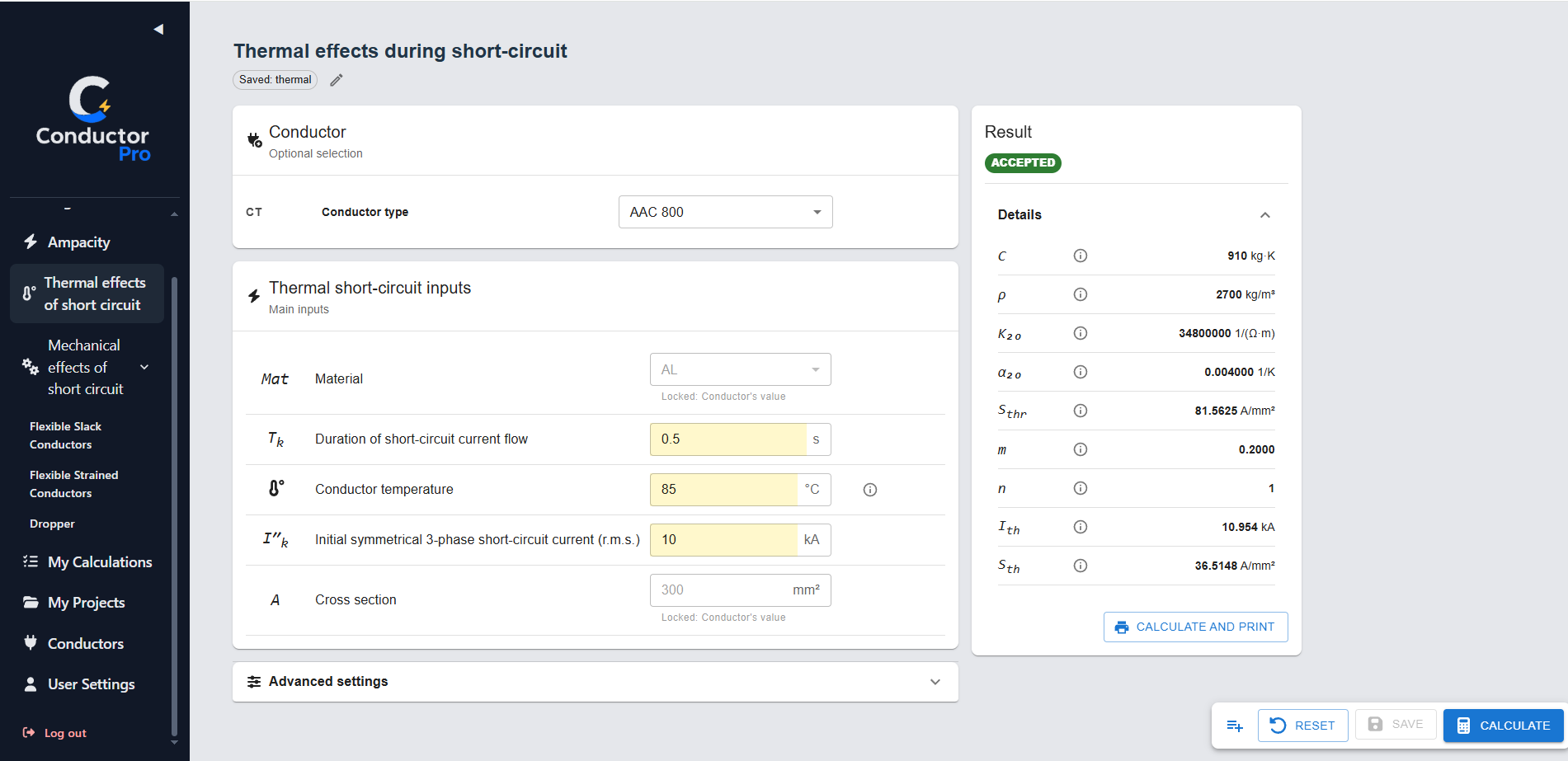
ConductorPro checks conductor short circuit withstand by comparing the thermal demand of a fault with the thermal capability of the conductor. The engineer specifies the conductor material and cross-section, the fault current and its duration, the frequency, and the initial and final conductor temperatures.
The short circuit thermal analysis produces the thermal equivalent short-circuit current and the equivalent current density, and compares them with the rated short-time withstand current density. The outcome is an explicit conclusion on whether the conductor has sufficient thermal withstand for the specified fault current and duration.
Inputs
Each assessment is defined by the conductor and the fault scenario.
- Conductor material
- Conductor cross-section
- Fault current
- Fault duration
- Frequency
- Initial and final conductor temperatures
Results
The calculation is followed by an explicit conclusion on whether the conductor has sufficient thermal strength for the case studied.
- Rated short-time withstand current density
- Thermal equivalent short-circuit current
- Equivalent current density
- Sufficient thermal strength: yes or no